The historical opening introduces Jane Goodall’s observations of chimpanzees using plant stems as tools. Watching carefully can reveal something unexpected.
What might you miss if you looked only once?
ORIGINAL BOOK ART / PAGE 20
An ordinary leaf, close to home.
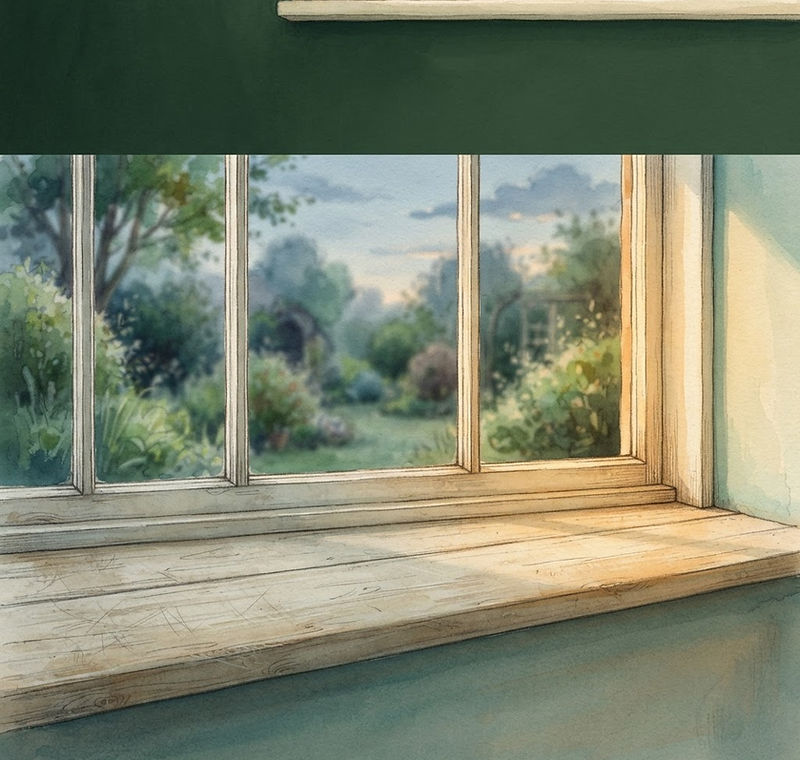
The story turns from a faraway observation to a family at a windowsill. An everyday object can be worth the same patient attention.
What is nearby that you have never looked at closely?
ORIGINAL BOOK ART / PAGE 24
One detail becomes a shared idea.
The family’s reflection makes room for looking together, drawing, and listening. Someone else’s observation can change what you see.
Would your grown-up notice the same detail?
ORIGINAL BOOK ART / PAGE 28
Questions can wait until morning.
The story leaves the notebook, leaf, and magnifying glass nearby as the family gets ready to rest. Curiosity does not require finishing.
What question would you like to keep for tomorrow?
The questions and descriptions here are companion interpretation, not quotations from the book. Historical artwork is interpretive; the family’s bedtime reflection is an original story.
Try “What did you notice?” before offering an explanation. Listen to their idea, look at the same detail together, and ask how you might find out. Leave time for a response; there is no need to fill every pause.
How do we use this together?+
Choose one illustration or one little exploration. Follow what interests your child, ask an open question, and give them time to respond. You can describe, draw, point, or simply look. There is nothing to complete.
What if I don’t know the answer?+
“I don’t know yet” is a good place to begin. Separate what you noticed from what you think might explain it. You can look again together, consult a reliable source, or leave the question for another day.
What about bedtime?+
Curiosity does not need to keep anyone awake. Read a little, share a question if you like, then let it wait. The book makes room for rest, not a final task or a perfect answer.
Are these activities a test?+
No. These are open-ended companion activities, not assessments or a promise of developmental outcomes. Adapt them to your child’s interests and abilities, supervise outdoor exploration, and leave wildlife undisturbed.
For parents · A reading companion for a real moment
Encouraging curiosity without needing every answer
What this book helps us practice
Notice something ordinary, wonder about it, look again and share an observation. Jane Goodall’s tool-use observation leads into Sloan, Mom and Cali looking at a leaf. There is room for questions and for rest.
On ordinary days, before a difficult moment
Make uncertainty comfortable during everyday conversation. Say what you noticed and what you do not know. Invite your child’s observation instead of testing recall. A safe familiar object is enough; an interesting question does not need an immediate correct answer.
When the difficulty is happening now
Choose the question that fits your moment. One shared page or a pause can be enough.
My child asks “why” all the time. How do I respond?
Choose one question you can explore together. Ask what caught their attention, then separate an observation from a possible explanation. Page 27 makes room for not knowing yet. You can look at the leaf’s edge, compare two observations, or agree to return later. You do not need to invent an answer to keep the conversation going.
How can I encourage a child who is afraid of getting the answer wrong?
Remove the quiz from the moment. On page 21, noticing the leaf is not a test. Ask for one detail they see, rather than a name they must remember. You can notice different things and both look again. A prediction in the shadow activity is an idea to explore, not a score or proof of ability.
What if questions keep coming at bedtime?
Keep one question nearby if the child wants, by drawing, telling you, or using the optional journal. Then let it wait. Pages 29–35 allow questions to rest until another day. Try: “That is a question we can keep. We can rest now.” This is a reading routine to try, not a promise to solve sleep difficulties.
Original companion guidance for You Are Curious, grounded in physical PDF pages 19–35. Suggested parent words are companion examples, not quotations from the book or historical figures. Shared reading offers a place to practice and talk; no prevention, treatment or outcome is promised.
Read a short part together. Ask what caught someone’s attention rather than checking whether they found the “right” detail. Pointing, describing, and drawing all count.
Try one small invitation
Choose one safe observation. Invite a prediction, make a little change, then describe what actually happened. Make room for an idea that did not match the observation.
Keep questions open
Use the journal as optional space for thought, not a worksheet to grade. Let children share if they wish, without collecting names, photographs, or responses through this site.
Adult-led, adaptable activities. No scores or promised learning outcomes. Read the publisher’s free edition separately; full book text is not reproduced here.
THERE’S ALWAYS TOMORROW
Your questions can wait nearby.
“They will not be lost because you rest.”
FROM YOU ARE CURIOUS
Tomorrow, is there something nearby you’ve never looked at closely? Go find out, with your grown-up.